Commercial trades · facilities · national programs
Every national wants it their way.
Your techs only have two hands.
CBRE wants one thing. Vixxo wants another. ServiceChannel wants a third — and that is before the end customer gets a say. We make one job collect exactly what that customer requires, and hand it back to your system without your crew learning six portals.
The problem you actually have
Every customer's rules. On one job.
If you subcontract to the nationals you already know this. Job confirmation, ETA, check-in, quotes and NTE thresholds, before-and-after photos, sign-off, invoicing back-up — every program wants a different shape of every one of those. Miss a field and the invoice sits.
Then it forks again underneath. The same national covers Public Storage, Dollar General, Aaron's, FedEx — and each of those sites has its own requirements too. Different photo counts. Different asset tags. Different escalation. Your tech is supposed to hold all of that in their head, on a ladder, on a Friday.
So the office chases it on Monday, and the money waits.
The workflow already knows
The job carries its customer, its site, its asset and its program. The steps that appear are the ones that customer requires — the tech never chooses a checklist or remembers a rule.
Adaptive per customer, per site
Public Storage needs four photos and a gate code. Dollar General needs a different sign-off. Same job type, different requirements, no second app and no second process.
Complete or it does not close
The gate is the data the program demands. If the invoice would bounce for a missing reading, the job will not finish without it — on site, while the truck is still there.
For the enterprise directing the work
What IVR check-in should have been.
If you are CBRE-style — facilities, multi-site, directing contractors large and small — you have been verifying work with a phone tree for twenty years. Call this number from the site phone. Punch in the work order. Hope.
Run it as a workflow over rich messaging instead. Carrier-validated GPS — the location the network vouches for, not a number typed into a keypad. Photo proof, timestamps, and the specific readings that program requires, from a sub who installs nothing and pays nothing.
Carrier-validated arrival
Check-in and check-out with location the carrier attests to. Not a spoofable app ping, not a phone tree, not a note typed later from the truck.
Your standard, their phone
Extend one operating standard to every subcontractor on the program — with nothing to install. If they can receive a text, they can run your process.
Scorecards that mean something
Because the proof is structured and identical across every vendor, vendor performance stops being anecdotal and starts being a query.
For the subs you dispatch
Nothing to install. Nothing to pay.
The hardest people to get compliance from are the ones who do not work for you. A two-truck sub is not adopting your software, will not attend your training, and will not pay for a seat. That is the whole reason programs settle for photos over text and a phone tree.
Send them the job as a message. They tap through it in the thread they already have open — the same validated steps your own crews run, the same proof coming back. No account, no download, no invoice to them.
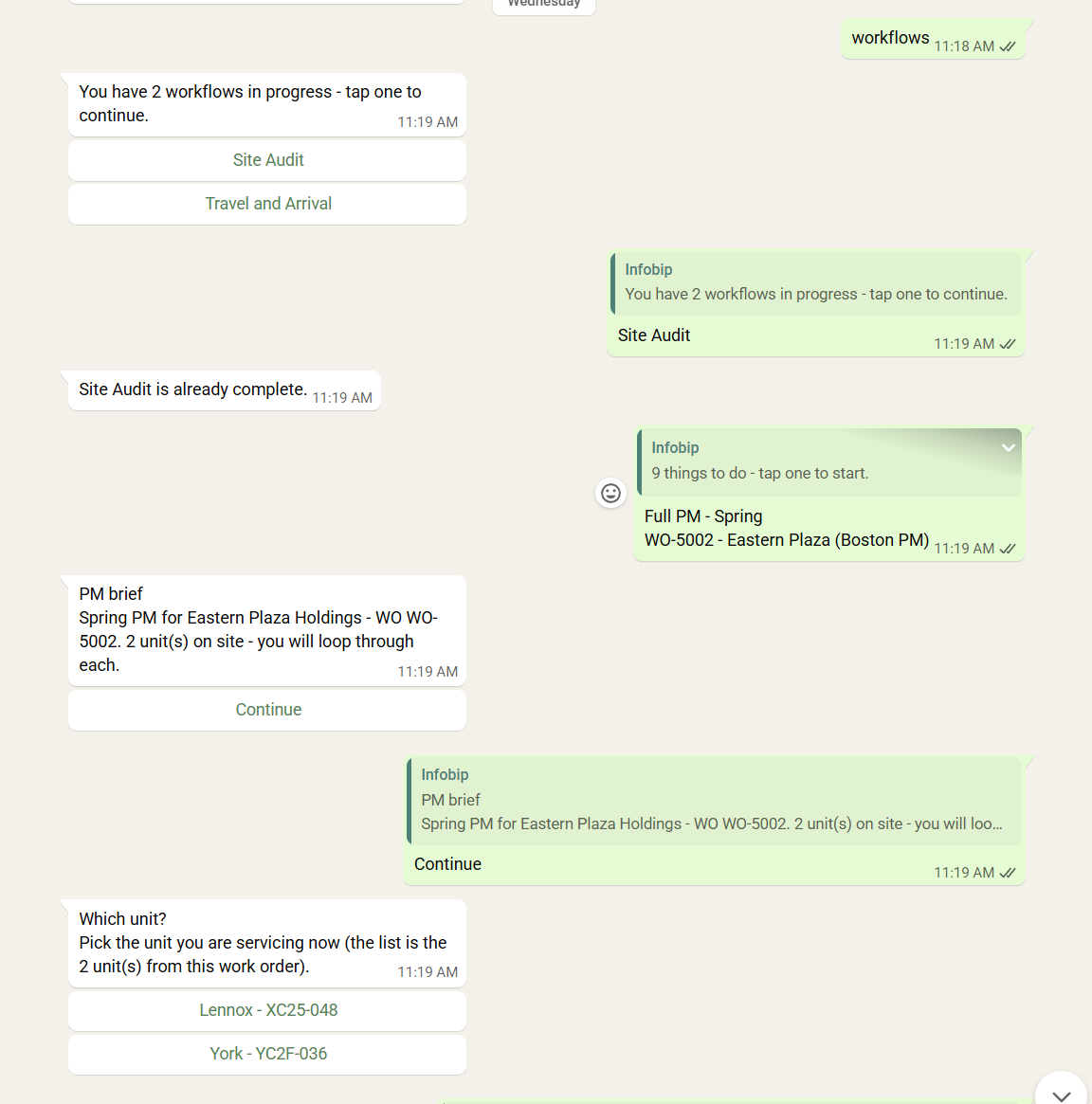
The job, in the thread a sub already has
We speak your trade
We already know how the job goes.
The workflow ships knowing your equipment, your readings and your paperwork — not a blank form you have to design from nothing.
Why this is different
We do not replace your FSM. We finish the job it started.
Keep dispatching where you dispatch. We sync just the job data we need — from your in-house system, your ERP, even your GPS provider — wrap it in the context of that customer's requirements, collect exactly what the program demands, and hand it straight back.
Start free
Bring every program's rules into one job.
Tell us which nationals you serve and what they demand. We will show you that job running on a phone.